Sunday, 19 April 2020

Lion took over South Africa road


Park ranger Richard Sowry was out on patrol on Wednesday when he snapped a pride sleeping on a road which would normally be busy with tourists.

But Kruger, like other wildlife parks, has been shut since 25 March as part of the coronavirus lockdown.

Big cats would usually only be seen by rangers on the roads by night.

How were the pictures taken?
As a ranger in one of Africa's largest game reserves, Mr Sowry performs an essential service and continues to work during the lockdown, checking on the wildlife and guarding against poachers.

While driving near Orpen Rest Camp on Wednesday afternoon, he spotted the lions on the road ahead and pulled up just five metres (5.5 yards) away to look at the unusual phenomenon.

As he took photos with his mobile phone, the lions did not seem bothered, most of them apparently fast asleep.

"Lions are used to people in vehicles," he explained. "All animals have much more of an instinctive fear of people on foot, so if I had walked up they would never have allowed me to get so close."

The oldest lioness in the pride is about 14, "which is very old for a lioness", so they are used to seeing vehicles.

Normally Mr Sowry would only see lions sleeping on the park's roads on colder nights in the winter, when the tar retains quite a lot of heat.

What rangers do not want, however, is for lions to start thinking that roads are a safe place just because they are now so still.

How is the lockdown affecting the park?
These quiet times have also seen lions as well as wild dogs venturing on to a golf course in the park but otherwise Mr Sowry does not think that the lockdown has had any major effect on the animals' behaviour yet.

"Kruger is a very wild place," he says. "It has been wild and it is still wild."

He is just happy to share his photos with people who cannot visit the park right now because of the coronavirus pandemic.

"These are difficult times for everyone and the intention was to bring people joy," he says.

To date, South Africa has recorded 34 deaths of people with Covid-19 and registered 2,506 cases of infection, making it the most affected country in Africa.

Its lockdown was extended on Wednesday by two weeks.

"Everybody realises the importance of the lockdown and the rangers are there to do their normal duties," says media officer Isaac Phaala. "To maintain the infrastructure takes quite a bit of work so that when the park opens, you don't start from scratch."

As for the lions, he adds, "normally they would be in the bushes because of the traffic but they are very smart and now they are enjoying the freedom of the park without us".

But why anyway, you might ask, would lions prefer tarmac to the softness of grass?

Probably for the simple reason that it had been raining on Tuesday night and, as Mr Phaala explained, "The tar was drier than the grass at the time - big cats and water don't mix."

Wednesday, 15 April 2020

Coronavirus: 'World faces worst recession since Great Depression'


Image copyright

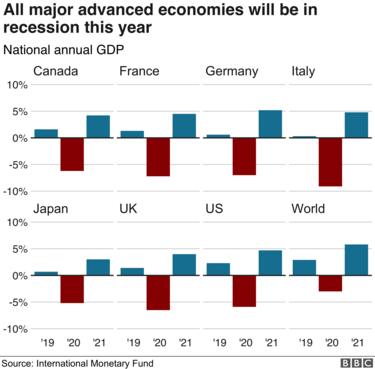
The global economy will contract by 3% this year as countries around the world shrink at the fastest pace in decades, the International Monetary Fund says.
The IMF described the global decline as the worst since the Great Depression of the 1930s.
It said the pandemic had plunged the world into a "crisis like no other".
The Fund added that a prolonged outbreak would test the ability of governments and central banks to control the crisis.
Gita Gopinath, the IMF's chief economist, said the crisis could knock $9 trillion (£7.2 trillion) off global GDP over the next two years.

'Great Lockdown'

While the Fund's latest World Economic Outlook praised the "swift and sizeable" response in countries like the UK, Germany, Japan and the US, it said no country would escape the downturn.
It expects global growth to rebound to 5.8% next year if the pandemic fades in the second half of 2020.

countries gdp

Ms Gopinath said today's "Great Lockdown" presented a "grim reality" for policymakers, who faced "severe uncertainty about the duration and intensity of the shock".
"A partial recovery is projected for 2021," said Ms Gopinath. "But the level of GDP will remain below the pre-virus trend, with considerable uncertainty about the strength of the rebound.
"Much worse growth outcomes are possible and maybe even likely."

Sharpest UK downturn in a century

The IMF predicts the UK economy will shrink by 6.5% in 2020, compared with the IMF's January forecast for 1.4% GDP growth.
A decline of this magnitude would be bigger than the 4.2% drop in output seen in the wake of the financial crisis.

job numbers

It would also represent the biggest annual fall since 1921, according to reconstructed Bank of England data dating back to the 18th century.
However, this is half the annual rate expected by the OBR, which expects GDP to drop by 35% in the three months to June.
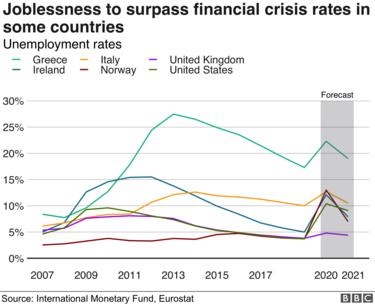
The UK's furlough scheme, which is designed to keep workers in a job amid the government lockdown, is expected to limit the rise in unemployment to 4.8% in 2020, from 3.8% last year.
UK Chancellor Rishi Sunak has pledged billions of pounds in wage subsidies and loan guarantees to help workers and businesses through the shutdown.
The Bank of England has also slashed interest rates to a new low and freed up billions of pounds for commercial banks to lend.

Global pain

Ms Gopinath said that for the first time since the Great Depression, both advanced and developing economies were expected to fall into recession.
The IMF warned that growth in advanced economies would not get back to its pre-virus peak until at least 2022.
The US economy is expected to contract by 5.9% this year, representing the biggest annual decline since 1946. Unemployment in the US is also expected to jump to 10.4% this year.
A partial recovery is expected in 2021, with expected US growth of 4.7%.

growth

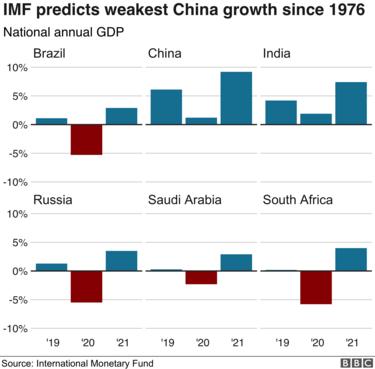
The Chinese economy is expected to expand by just 1.2% this year, which would be the slowest growth since 1976. Australia is expected to suffer its first recession since 1991.
The IMF warned that there were "severe risks of a worse outcome".
It said that if the pandemic took longer to control and there was a second wave in 2021, this would knock an additional 8 percentage points off global GDP.
The Fund said this scenario could trigger a downward spiral in heavily-indebted economies.
It said investors might be unwilling to lend to some of these nations, which would push up borrowing costs.
The IMF added: "This increase in sovereign borrowing costs or simply fear of it materialising, could prevent many countries from providing the income support assumed here."

Economic medicine

While longer lockdowns will constrain economic activity, the IMF said quarantines and social distancing measures were vital.
It said: "Upfront containment measures are essential to slow the spread of the virus and allow health care systems to cope and to help pave the way for an earlier and more robust resumption of economic activity.
"Uncertainty and reduced demand for services could be even worse in a scenario of greater spread without social distancing"
The IMF set out four priorities for dealing with the pandemic.
It called for more money for health care systems, financial support for workers and businesses, continued central bank support and a clear exit plan for the recovery.
It urged the world to work together to find and distribute treatments and a vaccine.
The Fund added that many developing nations would need debt relief in the coming months and years.
Source - BBC

South Africa -see what causes the clash between police and residents


People run away as a South African Police Services armoured vehicle drives into a street during clashes with residents of Tafelsig, an impoverished suburb in Mitchells Plain, near Cape Town, on April 14, 2020, after some people in the community did not receive food parcels which were being handed out as part of the support for this community during the nation wide lockdown to curb the spread of the COVID-19 coronavirus. (Photo by RODGER BOSCH / AFP)

China has approved early-stage human tests for two experimental coronavirus vaccines as it battles to contain imported cases and prevent a second wave of COVID-19


The experimental vaccines are being developed by a Beijing-based unit of Sinovac Biotech and by the Wuhan Institute of Biological Products , an affiliate of state-owned China National Pharmaceutical Group, state news agency Xinhua reported on Tuesday.

Al Jazeera's Sarah Clarke, reporting from Hong Kong, said China's National Health Commission also confirmed the trials will go ahead. 

In March, Beijing gave the green light to another clinical trial for a coronavirus vaccine candidate developed by the military-backed Academy of Military Medical Sciences and biotech firm CanSino Bio, shortly after US drug developer Moderna said it had begun human tests for their vaccine with the US National Institutes of Health.

"We can confirm now that three particular vaccines are being tested in China, and the National Health Commission has said it will have to clear a number of conditions before they can enable mass production of the vaccines globally," said Clarke.

As of Tuesday, China reported 82,249 coronavirus cases and 3,341 deaths. There were no fatalities over the past 24 hours.

'Very bold decision'

Scientists around the world are racing against time to develop a vaccine for coronavirus, which has killed more than 119,000 people and infected more than 1.9 million globally.

The first approved vaccine in China has started its second phase of the trial, Clarke reported.

"A total of 500 people signed up to volunteer for that in the first phase, which looked at the safety of this vaccine, and the second phase has now introduced a placebo control group," she said.  

But even as hope for a cure is raised, John Nicholls, clinical professor of Pathology at the University of Hong Kong, said: "Vaccines can't be rushed".

His team was one of the first outside mainland China to reproduce the virus in a laboratory for research. 

"Normally with vaccines you start off with small animals and then move to primates and then to the humans," Nicholls told Al Jazeera. "It seems that with this one they have gone straight to the humans, which is a very bold decision.

"Most of the mortality in this disease is in the elderly, so the best thing would be to actually see what the anti-body response is in the elderly rather than the young," he added.

Source  Al Jazeera

Monday, 13 April 2020

COVID -19 What is your say on this?


Coronavirus is no more a news, the whole world is feeling the heat of the virus originated from China.

Question of the day - lets assume this virus keeps spreading,what measure do you think can be put in places to curtail the spread as people continue with their daily routine?

COVID -19 China reports highest number of new cases in almost six weeks


China reported 108 new coronavirus cases in the past 24 hours, the highest daily total since March 5, the country’s National Health Commission said Monday.
While those numbers are still far short of the daily totals that were reported during the height of the country’s epidemic in February, the uptick is heightening fears of a second wave of infection that could once again push the country into a state of near-total lockdown.
Notably, all but 10 of the new cases involved people who entered mainland China from abroad. Nearly half were reported in Heilongjiang province, which borders Russia.
On Sunday, officials in the border city of Suifenhe announced that anyone coming from abroad would be required to spend 28 days in quarantine and undergo nucleic acid and antibody tests, Reuters reported. Harbin, the capital of Heilongjiang, plans to introduce similarly stringent measures and will also mandate 14-day lockdowns for any residential units where coronavirus cases are detected.
China also reported 61 new asymptomatic coronavirus cases on Sunday, a decrease from 63 a day earlier.

COVID -19 coronavirus patients who are put on ventilators have low rates of survival.

Recent research, however, suggests that coronavirus patients who are put on ventilators have low rates of survival. "If you go on a ventilator, there is about a 20 percent chance that you will survive," said Michael Dowling, CEO of Northwell Health in a Face the Nation interview on April 5.
The Intensive Care National Audit and Research Centre in the U.K. reported that 66% of patients on ventilators died. A University of Washington medical study published March 30 noted that nine of 18 patients died.
Infected patients can develop acute respiratory distress syndrome – ARDS – a condition with a high mortality rate. Those with ARDS build up fluids in the alveoli, the tiny air sacs in the lungs that transfer oxygen to the blood and remove carbon dioxide.
More than 40 percent of COVID-19 patients develop ARDS, according to a March 13 study from the Journal of the American Medical Association. Other serious respiratory ailments can also occur.
As the transfer process is impaired and oxygen levels fall, ventilators keep patients breathing. While they don't treat the disease, they do give patients time to fight it.
Bridge between life and death: Most COVID-19 patients on ventilators will not survive.
But coronavirus patients need more time – an average of 10 days, according to the University of Washington study. Other reports say one to two weeks is usual. A typical ICU patient averages 3-7 days, according to the National Center for Biotechnology Information.
The devices are removed once patients can breathe on their own.
Ventilators range in size and can cost $25,000 to $50,000 or more. They are used in intensive care units.

Lung sacs provide oxygen

How ventilators aid coronavirus patients

Ventilators gently pump air through a breathing tube into the patient’s lungs and allow the patient to exhale. This gives patients oxygen and removes carbon dioxide, which can damage the patient's organs if not expelled. In some cases, air with higher oxygen content is used. Settings are tailored to patient needs.
Patients can't talk because the tube passes through their vocal cords. The tubes can be uncomfortable and it takes time to get used to them, according to AgingCare.
Ventilator operation is closely monitored to maintain pressure and expiration levels.

How do ventilators help patients breathe?

Doctors monitor patient breathing rates per minute:
A popular mode used with ventilators is called assist-control (AC). In that mode, the ventilator assists with breathing. It's ideal for recovery because the patient only has to initiate a breath and the ventilator does the rest.
In this example, the respiratory rate is set to 15 breaths per minute. That means the patient will receive a breath every four seconds, regardless if the patient needs a breath.
Even if the patient attempts a breath in between the timed breaths, the ventilator will take over and deliver the same volume of air as the timed breath.

Hooking up coronavirus patients to ventilators

Patients are connected to ventilators in three ways. Though patients are sedated for the invasive procedures, the process of putting tubes in patients can be dangerous for health care workers, who risk being infected themselves. There's also a risk of infection for patients with breathing tubes.
Non-invasive mask:
In less critical cases, oxygen can be delivered through a face mask instead of a tube. This type of ventilator can be more commonly available in some areas and is relatively safe to deploy.
Endotracheal tube:
For more invasive procedures, medical workers don protective clothing and sanitize and sterilize the ventilator equipment.
A specialist called a respiratory therapist inserts a laryngoscope into the patient’s mouth and guides the endotracheal tube into the windpipe.
Once the tube is inserted, a cuff is inflated to keep the tube in place and seal out secretions. The laryngoscope is removed and the tube is taped to the side of the face. The tube is checked to make sure it can equally inflate both lungs.The endotracheal tube is attached to the lines running to the mechanical ventilator.

Tracheotomy:This is a more invasive procedure with an incision in the windpipe for insertion of a tracheal tube. This method is less likely to be used for COVID-19 patients since it puts the health care team at increased risk from aerosolized viral particles which can remain infectious for up to three hours.
Shortage of ventilators looms
Health officials warn of a critical shortage of ventilators as COVID-19 infections continue to rise. Hospitals are estimated to have about 160,000 ventilators with another 12,700 in the federal National Strategic Stockpile.
Demand, however, may exceed supply. Governors in New York and Louisiana said their states could run out of ventilators this week. The University of Washington's Institute for Health Metrics and Evaluation projected more than 25,000 ventilators could be needed by mid-April alone.
In response, Ford and General Motors are setting up production lines, Ford in Detroit and GM in Indiana, in emergency efforts to build ventilators. Ford will build 50,000 ventilators, while GM plans 30,000. Tesla and Dyson are also working on ventilators

Sunday, 12 April 2020

Witchcraft missed her route on her way to Meeting


A woman called Nkechi from Umunu Ngwa Enugu State in the eastern part of Nigeria who is a witch was seen lying helplessly After she crashed over one Mr Ugwu Erua rooftop while allegedly flying in the night.
The woman was asked what she was doing on someone’s roof by some people who were gathered there but she refused to disclose anything until she was forced by one of the people who went and get a matchet acting as if he wants to chop off the woman’s head before she spoke.
‘’ I am sorry, I was flying to another place, not this family but I crashed as I got at the rooftop of the house, I didn’t know what was the problem’’ ;aid Nkechi
‘’ There is a powerful force operating here, I have been flying for over 30 years but never got caught, please don’t kill me ‘’ ;
she pleaded
See photos:

Covid-19: with 533 patients, Côte d'Ivoire becomes the epicenter of the pandemic in West Africa

This is really not a list of achievements to be honored, and it is good to draw everyone's attention to it so that everyone feels challenged at their level. Côte d'Ivoire, a month after discovering its first case of the contaminated virus, on March 11, has just taken the lead in the countries most affected by the coronavirus in West Africa.

While Senegal and Burkina Faso led the pack, Ivorians today record 533 cases of people with covid-19, including 58 cured and 4 deaths.


With this number, Côte d'Ivoire supplants Burkina Faso, which has 484 confirmed cases, 155 of which have been cured and 27 who died on this Saturday, April 11, 2020. While Senegal, one of the first countries hit by the pandemic in the Uemoa zone, maintains its number of positive screened persons at 278, including 152 cured, 2 deaths and above all a drop in the rate of contamination.

Neighboring Ghana, with more than 300 cases, is in 3rd position among the most affected countries, while Nigeria and its almost 200 million inhabitants is struggling to contain the spread of the deadly virus.

This arithmetic evolution of the contamination curve in Côte d'Ivoire confirms the laxity and indiscipline shown by part of the population at the outset, in the implementation of the first barrier measures taken to avoid the spread of the pandemic. `

Today, the position of the most affected country in the sub-region does not honor the Ivorian state. On the contrary, it is a bad blow for the first economy of Uemoa and this flagship country of the Cedeao area. Ivory Coast is blacklisted in terms of health security. A bad reputation which could impact its frequentability once the containment measures are being lifted in the world.

This situation calls for maintaining, or even redoubling, vigilance in control over the implementation of barrier measures until the reversal of the ever increasing curve. Which, for the moment, makes Ivorian territory the epicenter of the pandemic in West Africa. An image of which the Ivorians cannot be proud after having delivered to the world the shameful spectacle, a few weeks ago, of a people who gave the appearance of defying the deadly virus imported from China.

SUNDAY JATO REAL AGE

 SUNDAY JATO REAL AGE Sunday Jatto Real Name The lengthy introduction I provided at the beginning of this post states that Sunday Jatto’s re...